Digital Signature Platform
Iran Fava Gostaresh · IKCO Group
- React 19
- Vite
- React Compiler
- TanStack Query
- FIDO2 / WebAuthn
- IranSign PKI
- eKYC
- OIDC / SSO
- MediaRecorder
- react-pdf
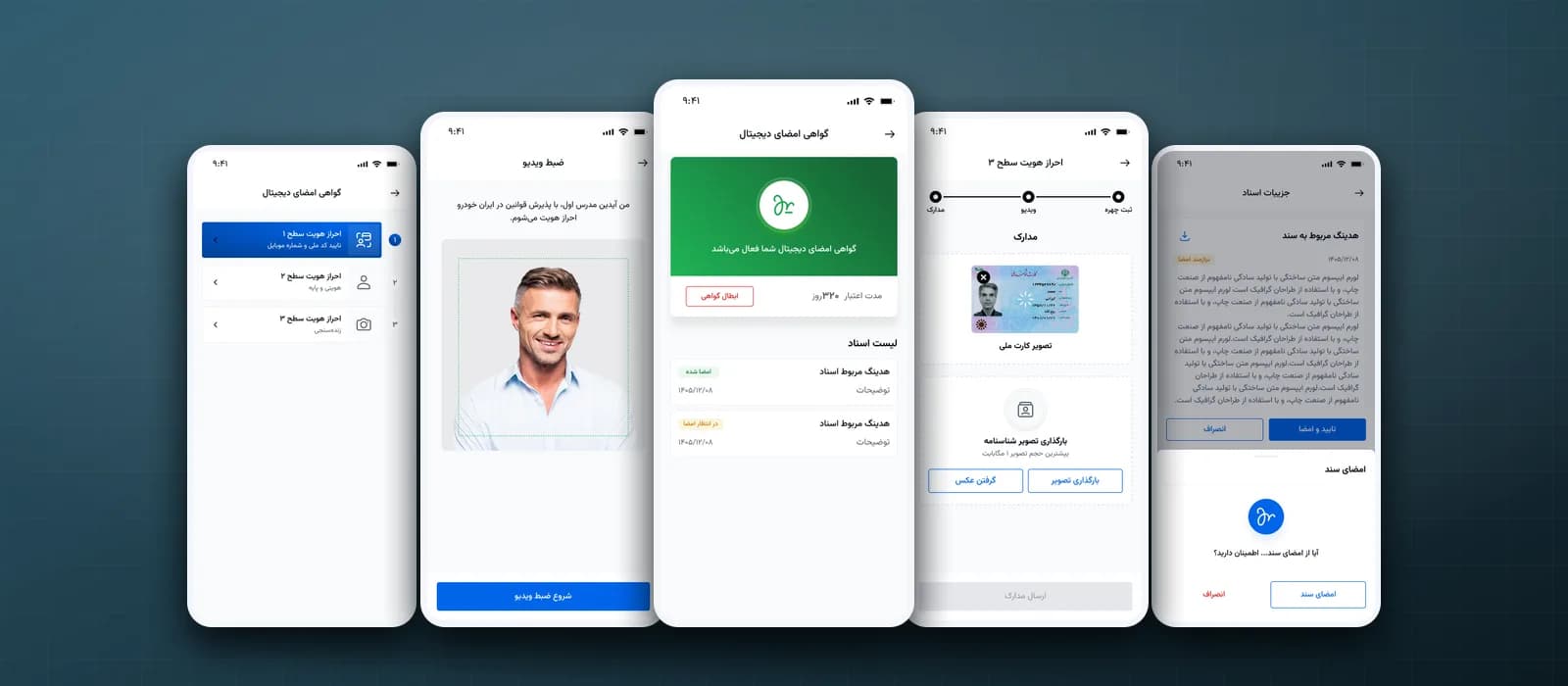
The app a customer opens when a purchase - most often a vehicle contract - needs a legally binding signature. It takes them through identity verification, issues a signing certificate tied to their phone, and then lists the contracts waiting for them: preview, download, sign. Verification and certificates run on IranSign’s services, identity checks on the national registries, and the contracts come from the group’s own platform; the app is the one place where all of it meets the user.
The challenge
A mobile web app for issuing a digital signature certificate and signing contracts with it: three levels of identity verification ending in a liveness check, a certificate bound to the phone through a FIDO2 credential, and IranSign’s PKI behind it.
Signing flows fail in a specific way: they are the step where users are most likely to abandon, and also the step where you have the least freedom to simplify. Identity verification, certificate issuance and signing each involve an external system with its own latency, its own failure modes and its own idea of what a session is. The certificate lives on one phone, so the same account can be fully verified on the server and still unable to sign on the device in the user’s hand. The liveness step asks a phone browser to record video that a server will accept - and Safari and Chrome disagree about how. And nothing in the flow can be fudged: an ambiguous state in a signing UI is a legal problem, not a UX complaint.
What I did
- Set the project up - React 19 on Vite with the React Compiler, TanStack Query for server state, oxlint - and laid out its structure: a page per verification level, an API module per backend (IranSign, its PKI, the group’s own API), and one small service that wraps the signing SDK’s FIDO calls so nothing else touches it directly.
- Built the certificate status page, the screen the whole app hangs off, and the revocation flow behind it. Revoking a certificate revokes it with the registration authority and with the signing service, then removes the credential from the phone, so no half-revoked state is left behind.
- We derive the verification levels from the systems of record on every visit instead of storing progress in the app: level 1 from Shahkar (the national ID matches the mobile number), level 2 from the user’s identity profile, level 3 from a liveness result - and a valid certificate makes an expired liveness check irrelevant. A user who leaves halfway comes back to the first level that is not done, not to the start.
- Issuing a certificate binds it to the phone. A fresh FIDO2 credential is created with the device’s face or fingerprint unlock and protects the key pair; any older credential is removed first, and if issuance fails the new one is removed too, so a retry always starts clean.
- A certificate that is valid on the server but has no credential on this phone is its own state, not an error: the page says the certificate lives on the phone it was issued to and offers the two ways out - sign in on that phone, or revoke and issue a new one.
- The liveness video uses a sentence fetched fresh from IranSign for every recording and is checked for both face and voice, so a recording cannot be replayed. Recording prefers H.264/AAC MP4 and falls back to WebM, Safari records at a lower resolution and bitrate, and anything over 10 MB is stopped before upload.
- Camera and microphone failures are classified - permission denied, no device, device busy - and watched through the Permissions API where the browser supports it, so each failure gets its own message instead of a generic one.
- Identity documents go straight to storage through a pre-signed upload URL with progress, then are confirmed; the 1 MB limit is checked before upload, and submit stays disabled until both the national ID card and the birth certificate are in.
- Sign-in is OIDC against the group’s SSO with an expired-session prompt; the tokens for a signing session are held in memory only, and request data that had been written to localStorage was taken out.
Key features
- Three-level identity verification: national ID and mobile, identity profile, and liveness - selfie, a random-sentence video and images of the national ID card and birth certificate.
- Signing key protected by a FIDO2 / WebAuthn credential on the phone, unlocked with face or fingerprint.
- Full certificate lifecycle: issue, remaining validity in days, and revocation at both the registration authority and the signing service.
- Video capture that works across Safari and Chrome: H.264/AAC first, WebM fallback, Safari-specific resolution and bitrate, 10 MB cap.
- Contracts in the app: listed by status (awaiting signature, signed, expired), previewed as PDF, downloaded and signed.
- OIDC single sign-on; signing-session tokens never written to storage.
Result
Identity verification, certificate issuance and revocation run end to end against the real services, and contract signing - listing, previewing and signing the group’s contracts - is the most recent piece to land. Because progress is read back from the systems of record, leaving halfway costs a user nothing: they continue from the first level that is not done.
Screens
Select a screen to see it full size.